The Future of Automation
If AI is the electricity of this era, the biggest opportunity isn’t the appliance built on top. It’s the grid. The orchestration layer that lets intelligence move through the world and do work. That layer is under-built, and that’s what we’re building with B3OS.
Modern AI is a horizontal enabling layer. It can be used to improve everything. It will be in everything. This is most like electricity. These kind of horizontal layers like electricity and compute and now artificial intelligence, they go everywhere. There is not a single application that you can think of that is not going to be made better by AI - Jeff Bezos
Bezos said this in December 2024. The framing has stuck with me ever since. It feels obviously true, and it raises a sharper question: if AI is the horizontal enabler of this era, why hasn’t anyone applied that idea to crypto?
The current experiments are good. Most still feel microscopic relative to the prize. Too much of it is wrappers around narrow use cases like DeFi agents, research agents, payments agents, Telegram bots, support agents, chatbots, etc. A few teams like Bittensor, Venice.ai, and USD.ai think at the platform level, but they’re the exception in an industry that used to pride itself on breaking the rules.
Most AI capital is flowing to hyperscalers and stonks (Allbirds anyone?), not crypto. That should tell us something. Some agents will be useful, sure. But as an industry, we’re at risk of missing the forest for the AI redwoods.
Somewhere along the way, crypto stopped asking the biggest questions.
What happened to game-changing goals like onchain central banks? Quadratic funding for public goods? Perpetual internet-native institutions?
The idea that crypto could produce not just new apps, but entirely new rails, institutions, and forms of coordination seems like a thing of the past in today’s world.
Onchain helps AI. I won’t belabor the point. Onchain has a lot of what AI agents need: moving value programmatically, authenticating actions, creating audit trails, verifying operators cryptographically, all on open, censorship-resistant rails.
But agents need more than rails. They need an orchestration layer and execution engine to carry context, handle failures, and coordinate action across tools and environments.
Opportunity for B3OS
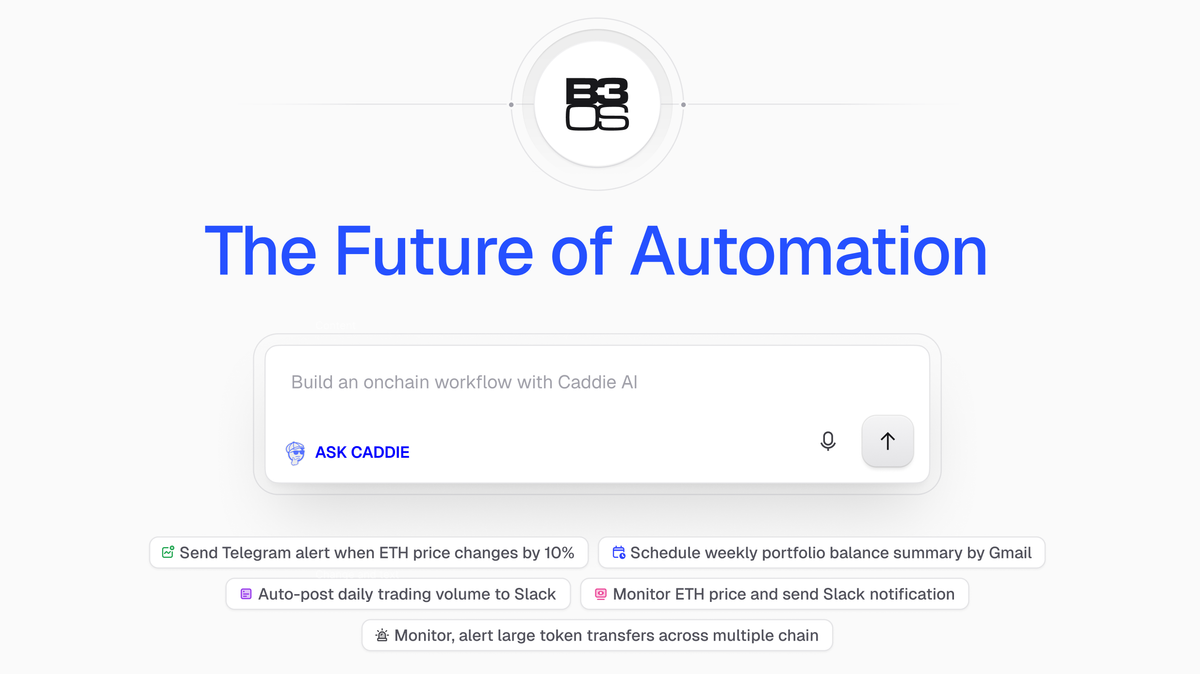
B3OS is not just another Zapier, and it is not just another use-case specific agent. The idea is much closer to an orchestration layer: an AI-native execution engine that connects user intent to action across onchain and offchain environments. We start with onchain workflows because onchain rails are natively compatible with agents, but the ambition is bigger than onchain alone.
Said another way, we are building the connective tissue between LLMs, which provide intelligence and execution across onchain and offchain systems.
I quoted Bezos because the Amazon analogy is relevant to B3OS. Amazon is still the clearest bits-meets-atoms company of the last thirty years. The internet was the horizontal enabler of that era. The real insight was not just that the internet mattered, but how to connect software to the physical world at scale. Amazon applied the internet to books, but books were just the wedge.
That’s where B3OS is now. Onchain actions are the books.
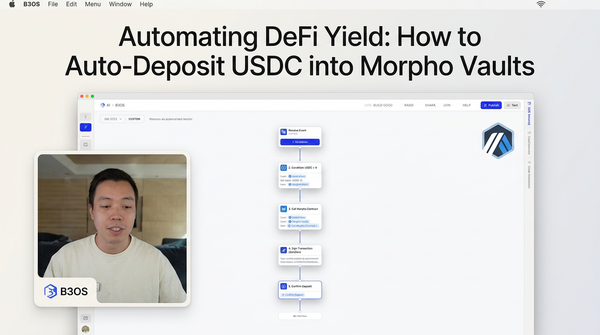
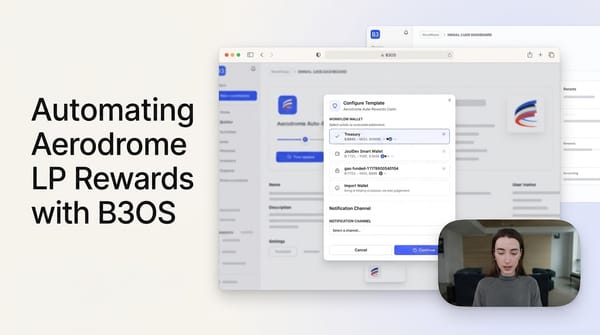
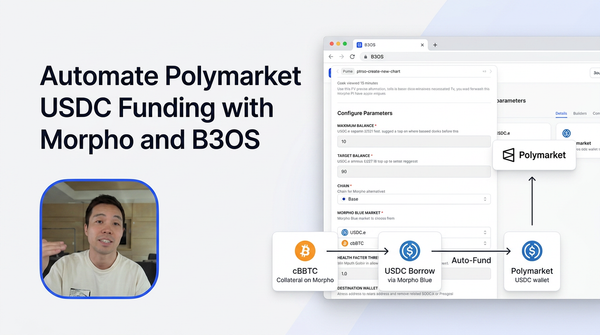
In our public beta, B3OS mostly looks like digital-to-digital activity. Automated workflows that coordinate DeFi actions, trade prediction markets, trigger notifications, and handle a bunch of the repetitive work. That is useful, but it’s just the wedge.
The endgame is to build the layer that lets AI agents move from software into the tools that touch everyday life. Over time that means expanding into your phone, IoT, robotics, Teslas, home systems (which our CTO has already started wiring up), wearables and basically everything downstream of computation and upstream of everyday life.
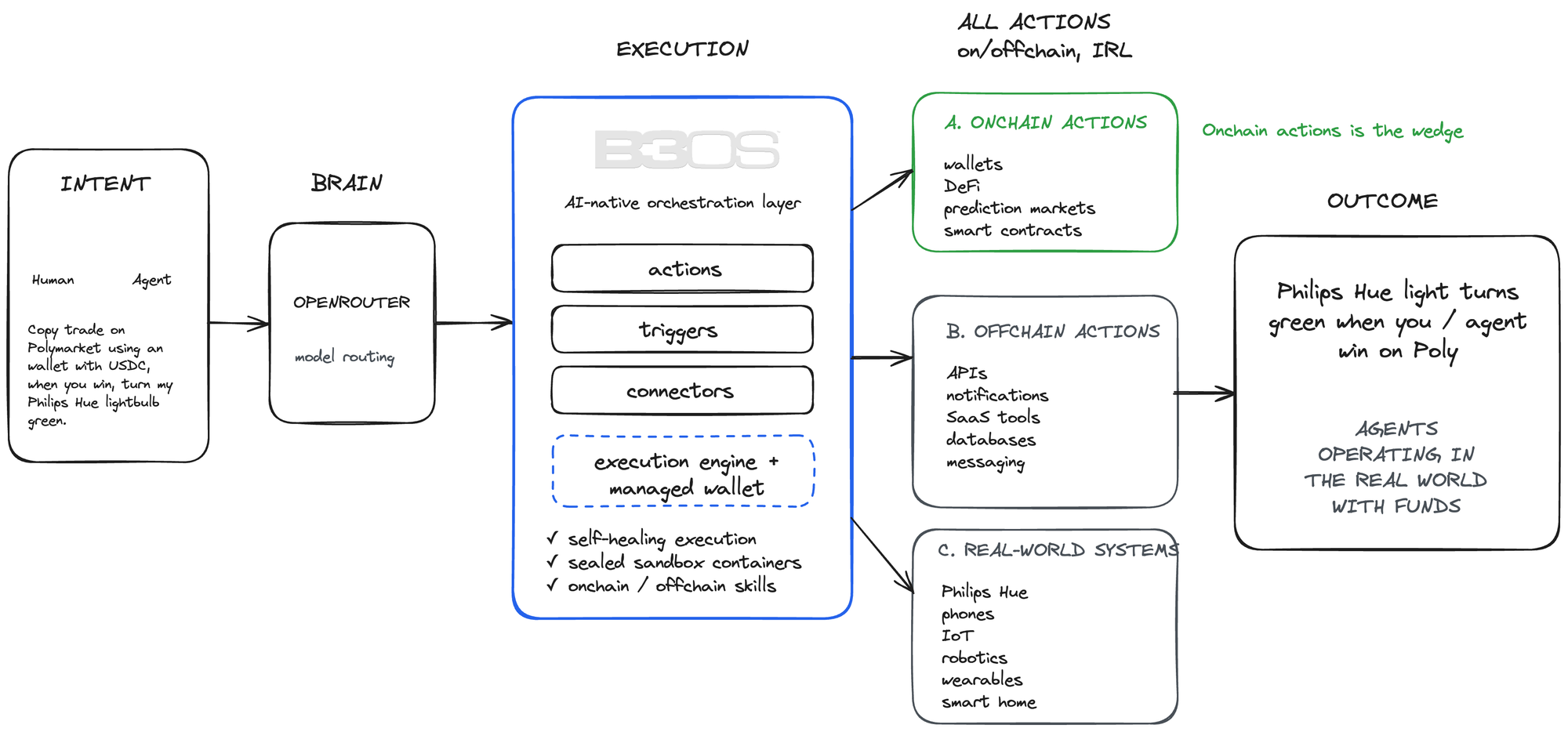
That is why we have a Philips Hue demo workflow, even if it looks silly at first. As Chris Dixon likes to say, many important things start out looking like toys. The point is not the lightbulb. The point is that B3OS can connect onchain events to everyday tools.
Once you see it through that lens, the path becomes much easier to imagine. Onchain events can enable agents to command the physical world, syncing onchain activity with robots, smart homes, energy grids, and eventually much more.
That is what B3OS is: an AI-native orchestration layer that begins with onchain action and expands outward into the broader systems agents will need in order to operate in the real world.
B3 Ecosystem
Taking a step back, that’s also how we think about the broader B3 ecosystem.
Amazon, in simple terms, built an app layer, an infrastructure layer, and a hardware layer. The app layer was things like Amazon retail, Prime Video, Twitch, and Audible. Underneath that sat the digital and physical infrastructure: AWS, physical stores, fulfillment, and logistics. Then there was the hardware layer: Echo, Kindle, Fire TV, Ring.
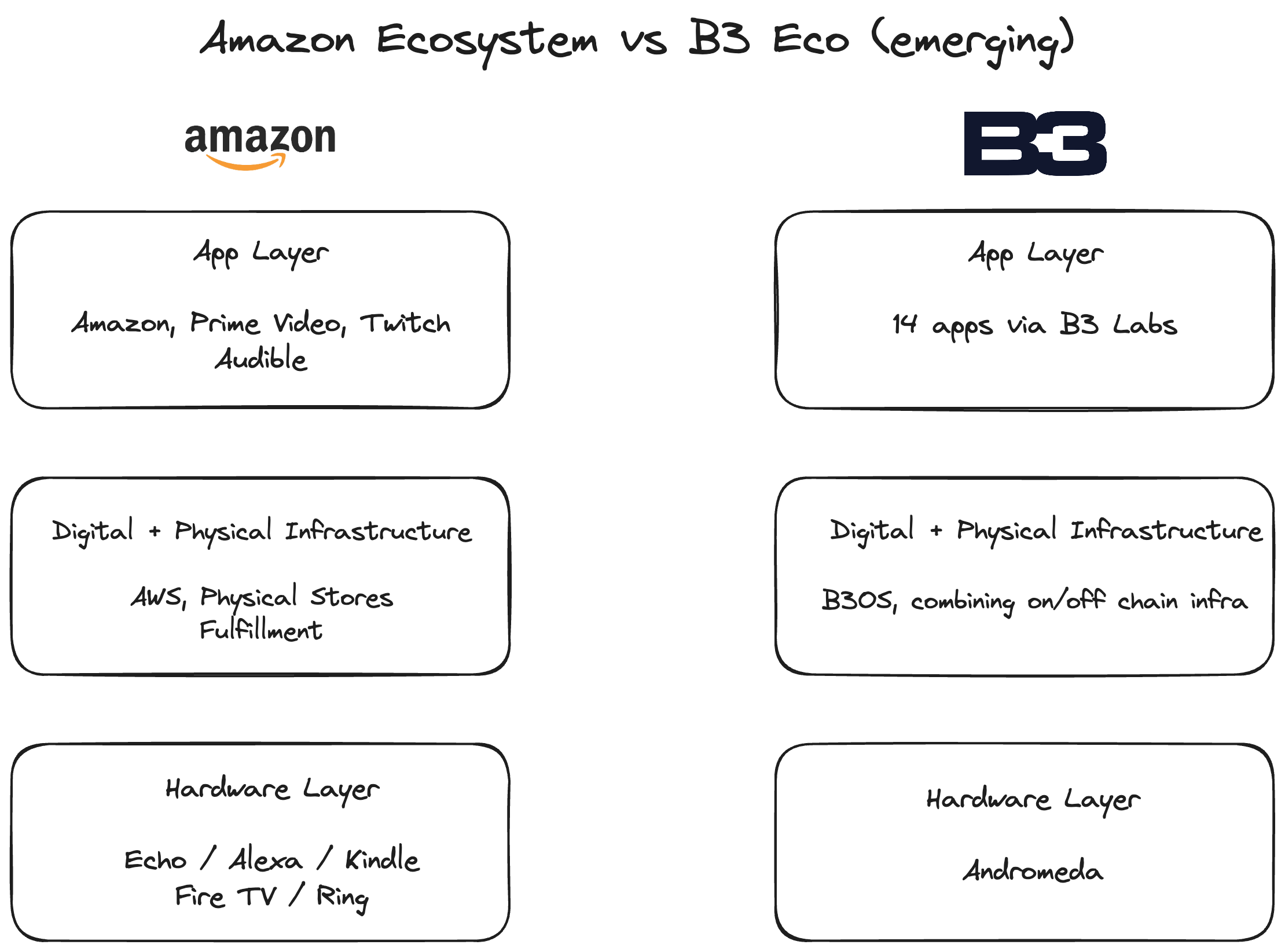
We think the B3 ecosystem will look similar. The app layer is B3 Labs: Caddie, skills, and workflows. Underneath that sits B3OS, the digital and physical infrastructure layer: the orchestration system that connects intelligence to execution and real-world endpoints. Then there is the hardware layer, starting with Andromeda.
That is the bet behind B3 in a post-AI world. Just as the internet enabled Amazon, we believe AI will enable B3.
- CEO Daryl Xu